C4 Engine User Integrates Tactile VR Suit, Appears on Discovery Channel
Eric Lengyel • May 27, 2006
Robert W. Lindeman, Assistant Professor in the Department of Computer Science at Worcester Polytechnic Institute (WPI), recently integrated support for a tactile virtual reality suit named the “TactaVest” into the C4 Engine. A documentary featuring the TactaVest aired on the Discovery Channel show Daily Planet in Canada on May 26. The video is available on YouTube.
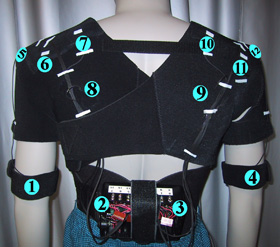 The TactaVest employs 16 motors called tactors to provide touch cues to its wearer.
Pictured above, the TactaVest is a garment worn on the upper body that incorporates 16 pager motors called tactors. The tactors are distributed at locations where they are most likely to be in contact with the wearer, such as the elbows, shoulders, and back, and are controlled by a custom circuit board that has a wireless connection (currently Bluetooth) to a host computer. Each tactor can be individually set to one of 200 vibration intensity levels, and the whole system can run from a single off-the-shelf rechargeable battery.
At WPI, Lindeman’s research goals include providing “a unified framework for incorporating cues for multiple sensory modalities, so that programmers can easily take advantage of the richness of the human sensory systems to provide better experiences to users.” Virtual reality systems have historically focused on achieving the most realistic visual cues possible, and auditory cues have also been extensively researched. The remaining three senses—smell, taste, and touch—have not received nearly as much attention, but there was a notable attempt to market a fragrance-producing device called the DigiScent iSmell to gamers in 2000 (which was ultimately unsuccessful). The TactaVest was designed to target the touch sense by adding contact cues to virtual environments, and it overcomes the computational expenses and physical size limitations of earlier designs that prevented their general use in games.
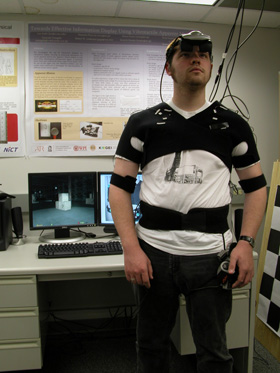 Eric Sutman, an undergraduate student at WPI, puts the TactaVest through its paces while running around
inside the C4 Engine. He moves the player using a hip-mounted controller, and the head-mounted display
shows him the same scene that is visible on the monitor behind him.
Eric Sutman, an undergraduate student at WPI, puts the TactaVest through its paces while running around
inside the C4 Engine. He moves the player using a hip-mounted controller, and the head-mounted display
shows him the same scene that is visible on the monitor behind him.Support for the TactaVest was integrated into one of the demo worlds that ships with the C4 Engine, and it currently provides touch cues based on the general direction and magnitude of any collision between the player and the environment. Future work will focus on improving the realism by making use of more fine-grained collision information such as contact between the player’s arm and an object. When asked about the process of integrating the TactaVest into the C4 Engine, Lindeman said, “We were able to implement our current proof-of-concept in just three days, because of how cleanly C4 itself is implemented. With the help of the online C4 user community, we were able to understand how the code fits together, and decide where best to place our code. It was very straightforward.” Lindeman further cited the engine’s rendering capabilities, its well-designed architecture, and its price as reasons that he chose C4 as the platform upon which TactaVest integration would be carried out.
See Also
- TactaVest: Integrating the sense of touch into video games on YouTube.
- C4 Engine website.